I build computational models to study magnetic and ferroelectric materials, combining condensed matter physics with high-performance scientific computing in Julia.
I am a PhD researcher in Electrical & Computer Engineering at Purdue University, working at the intersection of condensed matter physics and high-performance scientific computing. My dissertation, Phase Field Modelling of Quantum Metamaterials, is supervised by Prof. Pramey Upadhyaya.
I combine analytical models with Julia simulations to study magnetic order and ferroelectric polarization. Before Purdue, I designed satellite electronics at ISRO and established a semiconductor device characterization lab.
I study how currents control noncollinear magnetic order in Mn₃Pt-type chiral antiferromagnets. Analytical models and numerical simulations reveal spin dynamics, switching paths, and the effects of current-induced torques.
I develop phase-field simulations to study how polarization textures evolve and respond to excitation in STO/PTO ferroelectric structures. Spectral numerical methods couple polarization dynamics with electrostatics.
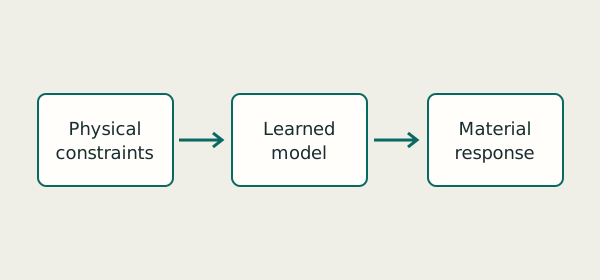
Learning with physical constraints · conceptual workflow
03
ML for Physics & Model Discovery
I explore physics-informed neural networks and neural operators for model discovery and surrogate modeling of dynamical systems, using physical constraints to guide learning from data.
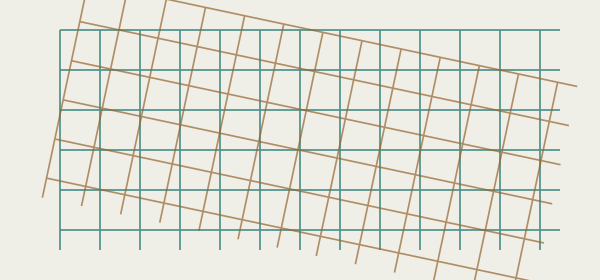
I use micromagnetic simulations to study how twisting magnetic layers changes their spin textures, investigating noncollinear magnetic phases and domain walls in moiré materials.
Chang Niu, Kisoo Nam, Aravindh Shankar, Jian-Yu Lin, Sanjeev Khare, Sumi Lee, Pramey Upadhyaya, & Peide D. Ye
arXiv:2608.09283 · cond-mat.mes-hall · August 2026
Direct density-of-states mapping probes size-dependent localization in oxide semiconductors.
Read summary
Lock-in electric-field penetration is used to map the effective density of states in In-based oxide semiconductor TFTs, showing that band-tail states become screening- and transport-active. Geometry-dependent DOS mapping reveals exponential suppression of the effective DOS with channel length — a microscopic origin of localization-induced threshold-voltage roll-off — and that disorder can be tuned via thickness, O₂ annealing, and In/Ga/Zn composition.
Guanghui Cheng, Shiva T. Konakanchi, Andres E. Llacsahuanga Allcca, Sanjeev Khare, Nithin Abraham, Yuqing Cao, Hechang Lei, Kenji Watanabe, Takashi Taniguchi, Pramey Upadhyaya, & Yong P. Chen
arXiv:2606.00604 · cond-mat.mes-hall · May 2026
Twisting magnetic layers produces noncollinear spin textures and 90° domain walls.
Read summary
Twisted CrCl₃ XY magnets host robust noncollinear moiré magnetism, with field-driven transitions from coexisting AFM and FM domains that persist up to double nine-layer stacks. Combined with micromagnetic simulations, the ground state is identified as the predicted “twisted-s” phase with 90° domain walls, and these phases are shown to be electrically tunable.
Computers and Geotechnics · Vol. 197 · 108180 · Elsevier · September 2026
Short-time Fourier synthesis addresses spectral bias in physics-informed viscoelastic modeling.
Read summary
Spectral bias — the tendency of neural networks to learn low-frequency components while missing high-frequency transients — limits PINNs for viscoelastic characterization of pavement geomaterials under time-varying loading. We developed a spectral temporal synthesis framework using inverse Short-Time Fourier Transform (iSTFT) operations, with learnable complex-valued spectral–temporal representations, to enable physics-informed learning of viscoelastic operators across millisecond-to-second timescales.
Simulation software, numerical methods, and visualization tools. Public repositories include a direct link. Other projects are research tools with no public repository linked here.
Three-sublattice spin dynamics for chiral antiferromagnets (Mn₃Pt). Includes NEB/CI-NEB solvers, collective-coordinate LLGS projection, SOT/STT torques, and GLMakie energy landscape visualization.
JuliaResearch code
No public repository linked
FerroElectricScripts.jl
Spectral ETD2RK + FFT solver for the Landau-Khalatnikov equation. Supports patterned contacts, Strang-split sponge boundaries, and ferron dispersion analysis in STO/PTO superlattices.
JuliaResearch code
No public repository linked
More research tools & development setup
RapidSolver.jl
High-performance ODE/DAE solver infrastructure for large-scale scientific simulations on HPC clusters, optimized for memory efficiency and parallel execution.
JuliaResearch code
No public repository linked
OvfViewer
Reader and GLMakie-based visualizer for OOMMF Vector Field (.ovf) files produced by micromagnetic simulations — 3D magnetization field inspection with interactive slicing.
JuliaResearch tool
No public repository linked
moire_micromagnetic_simulation
Simulation suite for moiré quantum material systems. Used to discover novel magnetization modes in twisted magnetic heterostructures arising from moiré superlattice potentials.
JuliaResearch code
No public repository linked
SemiconductorSim.jl
Drift-diffusion simulation of micro/nano semiconductor devices, developed during MS thesis work on high-frequency NEGF-Maxwell co-simulation for the DARPA NanoSim project.
JuliaResearch code
No public repository linked
FDMUtils.jl · PlotPatchGrid.jl
Finite-difference method utilities and patch-grid visualization tools for 2D/3D PDE solvers — structured mesh generation and field plotting for computational physics workflows.
Interested in computational physics, scientific machine learning, or high-performance simulation? Reach out to discuss research collaborations and internship opportunities.